
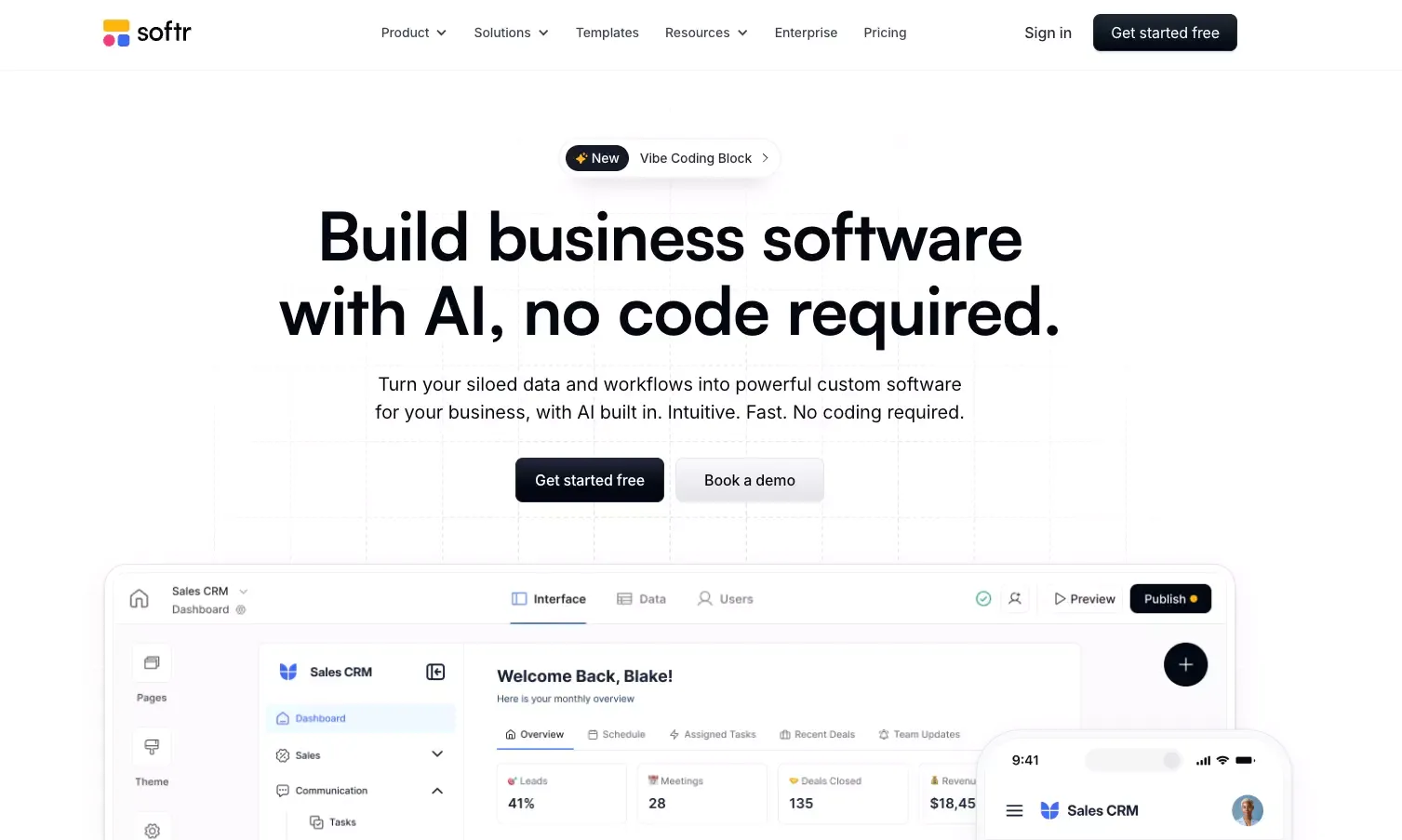
 Softr is still one of the easiest ways to build client portals, internal tools, and AI-powered dashboards on top of business data. It is fast, approachable, and especially useful for teams that want to launch operational apps without stitching together a full engineering stack.
But after comparing the market more closely, one thing became obvious: there is no single best Softr alternative for everyone.
That search usually hides a more specific need. Some teams want better mobile support. Some want more flexibility and deeper logic. Others want to move from a portal builder to something that feels closer to a real product platform.
That is why I would not compare Softr alternatives by feature count alone. I would compare them by what you are trying to build next.
Why People Start Looking for a Softr Alternative
In my view, Softr works best when the problem is already structured. You have data. You understand the workflow. You want a clean portal, dashboard, CRM, directory, or internal app. You do not want to spend weeks configuring infrastructure.
The friction usually starts when the app stops being a business interface and starts becoming a product.
The Most Common Reasons Teams Move On
- They want more product flexibility
- They need a stronger mobile experience
- They need deeper workflows and business logic
- Their app becomes operations-critical
- They are no longer just building a portal
- They want more room to scale without rebuilding later
Where Softr Still Works Well
- Internal tools
- Client portals
- Lightweight dashboards
- Membership-style apps
- Business apps with clear roles and simple workflows
Where Softr Starts to Feel Limiting
- Highly custom user experiences
- Complex workflow logic
- Mobile-first products
- Public SaaS applications
- Products that will evolve fast after launch
Quick Comparison of the Best Softr Alternatives
| Tool | Best For | Main Strength | Main Tradeoff |
|---|---|---|---|
| Atoms | AI-assisted product building | Broader product scope from idea to launch | Less ideal if you only need a simple portal |
| Glide | Internal tools and mobile-friendly business apps | Great balance of speed and usability | Less flexible for deeply custom products |
| Bubble | SaaS MVPs and custom web apps | Strong logic and customization | Higher complexity |
| Noloco | Internal systems and client portals | Structured data and permissions | Less product-oriented for public apps |
| Adalo | Native mobile-first apps | Visual builder with app store path | Not my first choice for every portal use case |
| WeWeb | Custom frontends with backend freedom | Strong UI control | More setup and technical thinking |
| FlutterFlow | App-style products across platforms | Serious mobile and app flexibility | Steeper learning curve than simpler no-code tools |
Why Atoms Is One of the Most Interesting Softr Alternatives
I want to put Atoms near the front of this list for one reason: it solves a different layer of the problem.
Softr is strong when the app structure is already clear. You know what the portal should do. You mostly need to assemble the interface, user permissions, and data views.
Atoms makes more sense when the harder problem is still product thinking itself. It works as a broader AI app builder — one that helps with structure, direction, and product readiness, not just screen generation.
Where Atoms Overlaps With Softr
- Both lower the technical barrier to building apps
- Both shorten the path from idea to usable software
- Both appeal to teams that do not want to assemble a full stack manually
Where Atoms Goes Further
- It fits broader product-building workflows, not just portal building
- It is better aligned with teams thinking about launch readiness
- It makes more sense when scope is still evolving
- It is useful when the challenge is not only building screens, but also shaping the product itself
- It lets coding agents carry more of the workflow across the build
When I Would Choose Atoms
- The project is moving toward SaaS, not just internal operations
- The product scope is still taking shape
- The team wants AI help with structure, not only generation
- The goal is a fuller product, not just a business interface
When I Would Still Choose Softr
- I need a portal quickly
- The data model is already defined
- The team is non-technical
- The app is operational rather than product-led
That is the real split. Softr is often the better tool builder. Atoms can be the better product builder.
Other Strong Softr Alternatives to Consider
Glide
Glide is one of the most common names in this category, and that makes sense. It is especially appealing for internal tools, portals, and business apps that need to work well on mobile.
Why I Would Choose Glide
- Fast to launch
- Clean user experience
- Strong fit for internal workflows
- Better mobile feel than many portal-first tools
Where Glide Fits Best
- Field operations
- Team tools
- Lightweight client portals
- Business apps used across desktop and mobile
Where I Would Hesitate
- Products that need deep customization
- Apps that are likely to become complex SaaS products
Bubble
Bubble is what I look at when "Softr alternative" really means "I need more power."
It gives much more room for logic, workflows, and product depth. That makes it a strong fit for SaaS MVPs and custom web apps. If you are already weighing several options in that lane, it is worth reading about Bubble alternatives to see how the surrounding field compares.
Why I Would Choose Bubble
- More flexibility
- Stronger workflow depth
- Better long-term runway for custom web products
- Better fit for teams building public-facing software
The Tradeoff
- More power means more complexity
- It asks more from the builder
- It is rarely the simplest option
Noloco
Noloco feels like one of the closest practical competitors to Softr for business use cases. It is especially compelling when structured workflows, records, and permissions matter.
Why I Would Choose Noloco
- Strong internal tool positioning
- Good fit for client portals
- Better for structured operations than flashy product experiences
- Useful when permissions and data relationships matter a lot
Best-Fit Scenarios
- Agency portals
- Internal CRMs
- Operations systems
- Back-office workflows
Adalo
Adalo belongs in the conversation whenever native mobile matters.
I would not treat it as the default replacement for Softr, but I would absolutely shortlist it when app-store distribution is part of the plan.
Why I Would Choose Adalo
- Native mobile direction
- Visual builder
- Better fit for app-style experiences than basic portals
When It Is the Wrong Fit
- Simple desktop-heavy portals
- Internal business apps that do not need a native app feel
WeWeb
WeWeb is a different kind of option. I see it less as a direct no-code replacement and more as a strong frontend layer for teams that want backend freedom.
Why I Would Choose WeWeb
- More frontend control
- Better for teams that already think in systems
- Useful when design flexibility matters
- Good fit if you do not want the backend dictated by the builder
Best For
- Product teams with APIs
- Teams with an existing backend
- Apps where frontend quality is important
FlutterFlow
FlutterFlow sits in a more app-oriented lane. It makes the most sense when the goal is to build a real app experience across platforms.
Why I Would Choose FlutterFlow
- Strong mobile direction
- More serious app-building path
- Useful for teams that want visual development without being boxed into simple templates
The Tradeoff
- It is not the easiest path
- It demands more product and implementation clarity than lightweight builders
Best Softr Alternatives by Use Case
| Use Case | Best Pick | Why |
|---|---|---|
| Internal tools | Glide or Noloco | Glide is smoother and more mobile-friendly; Noloco is stronger for structure and permissions |
| Client portals | Noloco or Glide | Both fit structured business access well |
| SaaS MVPs | Bubble or Atoms | Bubble offers flexibility; Atoms is better when product shaping matters early — an AI prototype generator workflow can also help bridge idea and build |
| Native mobile apps | Adalo or FlutterFlow | Both are more app-oriented than Softr |
| Custom frontend experiences | WeWeb | Better fit for teams that want UI freedom |
| Broader AI-assisted product building | Atoms | Stronger fit when the goal is more than a portal |
How to Evaluate a Softr Alternative Before You Migrate
Most teams make this decision too quickly.
They compare templates, pricing tiers, and landing pages. That is the easy part. The harder part is understanding what the app will become six months from now.
The Questions I Would Ask First
1. What Does the Data Model Look Like?
- Are records and relationships already clear?
- Will the app stay simple, or will workflows expand?
- Do different user roles need different levels of visibility?
2. How Important Are Permissions?
- Do you need staff views, client views, and partner views?
- Do you need row-level or field-level restrictions?
- Will permissions become more complex over time?
3. Are You Building a Portal or a Product?
- A portal exposes information and workflows
- A product creates its own distinct user experience
- Softr is strongest in the first category
- Tools like Bubble, FlutterFlow, WeWeb, and Atoms make more sense in the second
4. Who Will Maintain It?
- A tool chosen by one enthusiastic builder can become a burden later
- The right platform should still be manageable after launch
- Maintenance cost matters as much as setup speed
5. What Kind of Growth Do You Expect?
- More users?
- More logic?
- More integrations?
- More need for custom UX?
If the answer is yes to most of those, you should not optimize only for the fastest launch.
Common Mistakes Teams Make When Leaving Softr
Choosing for Templates Instead of Long-Term Fit
A polished template can hide a weak fit. It may look fast at the start and become painful later.
Underestimating Permissions
This is one of the biggest mistakes. Teams focus on interface polish and only later realize the real complexity is access control.
Moving Too Early to a Tool That Is Too Technical
More flexibility is not always better. Sometimes it just means more overhead.
Ignoring Future Product Requirements
A tool that feels good for version one may be the wrong fit for version three.
Switching Without a Clear Reason
Sometimes the right answer is not to leave Softr at all. If the app is still a portal with simple workflows, Softr may already be the right tool. If you are evaluating options in the same general category, looking at Glide alternatives can also help clarify where different tools draw the line.
Final Verdict
Softr is still a strong option for client portals, internal tools, and dashboards. It has not lost relevance. It still makes sense for many business apps that need to launch quickly and stay manageable.
But the best alternative depends on what kind of "more" you need.
My Practical Take
- Choose Atoms if you want to move from app assembly to broader product creation
- Choose Glide if mobile-friendly business apps matter most
- Choose Bubble if you need a true SaaS runway and deeper customization
- Choose Noloco if you care most about operations, permissions, and structured workflows
- Choose Adalo or FlutterFlow if native mobile is part of the roadmap
- Choose WeWeb if frontend flexibility and backend freedom matter most
The smartest Softr alternative is not the one with the longest feature list.
It is the one that matches the shape of the thing you are actually building.
 Posts
Posts 